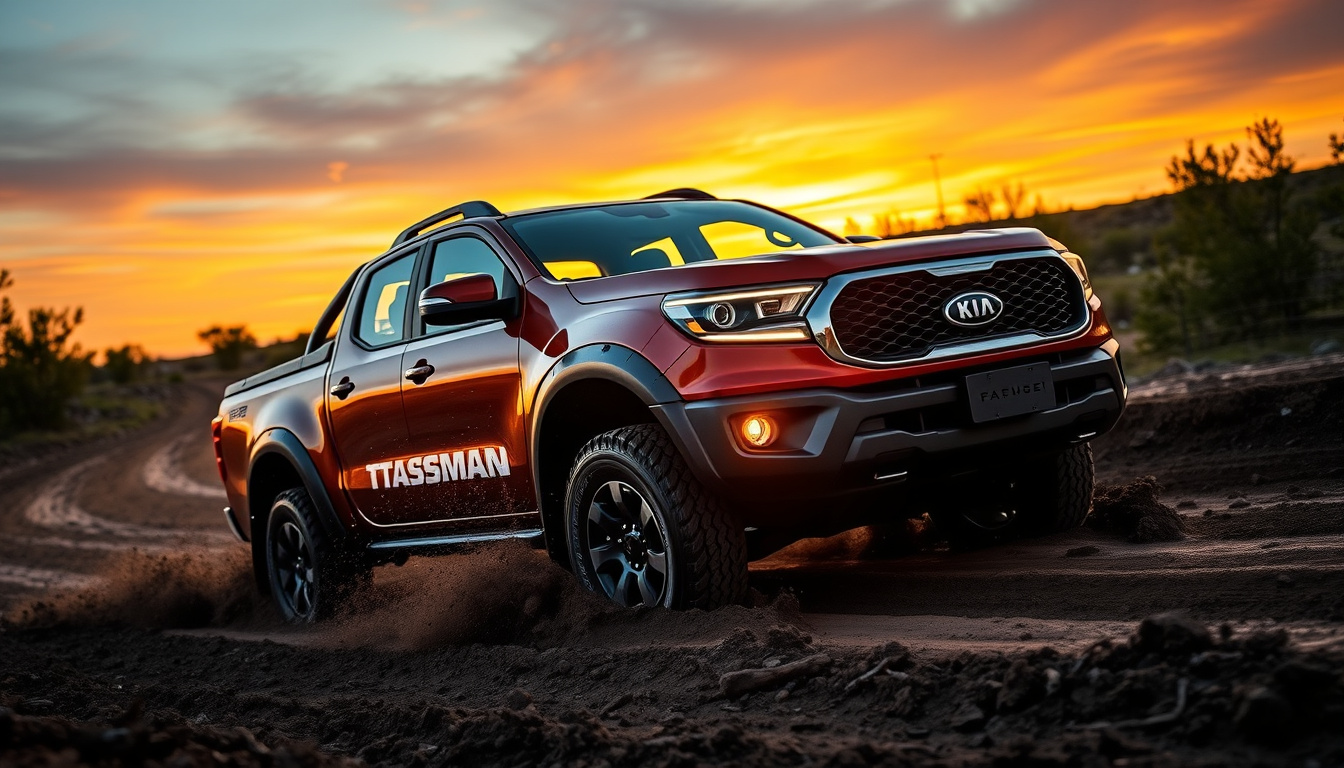
The Kia Tasman represents the South Korean manufacturer’s first serious push into the mid-size pickup segment, bringing a body-on-frame dual-cab ute to markets where competitors like the Toyota HiLux and Ford Ranger have dominated for years. Launched in Australia as a 2026 model in late 2025, the Tasman combines a 2.2-liter turbo-diesel engine with premium interior appointments that critics have praised as class-leading.
Early reviewers have noted that despite some divisive styling choices, the Tasman delivers a polished driving experience both on-road and off, positioning it as a credible alternative for buyers seeking something beyond the traditional options in this competitive segment.
What is the Kia Tasman?
The Kia Tasman is a purpose-built mid-size pickup truck that marks Kia’s entry into the body-on-frame ute market traditionally dominated by Japanese and American manufacturers. Unlike previous Kia trucks that shared platforms with passenger vehicles, the Tasman was developed specifically for the demands of the dual-cab ute segment, competing directly with established nameplates like the Toyota HiLux and Ford Ranger.
The vehicle’s bold styling features Kia’s “Tiger Face” grille, vertical headlights, and pronounced front bumper designed to emphasize width and capability. Critics have described the appearance as unconventional, with some noting it resembles a bottlenose dolphin in profile, though darker color options and stake-bed variants have been better received.
Based on an optimized platform with a 3,270 mm wheelbase matching the Ford Ranger, the Tasman measures slightly longer overall than some rivals while maintaining comparable width and height to other midsize competitors.
Overview at a Glance
| Design Highlights | Powertrain Options | Key Dimensions | Target Markets |
|---|---|---|---|
| “Tiger Face” grille, vertical headlights, fender flares with in-fender storage | 2.2L turbo-diesel, 206 hp, 324 lb-ft torque; 8-speed automatic | 128.7-inch wheelbase, 3,270 mm | Australia (primary), global expansion planned |
Key Insights
- Kia developed the Tasman as a dedicated body-on-frame platform, not derived from existing passenger car architecture
- The interior has been described as class-leading, surpassing rivals in material quality and technology
- Off-road capability testing has yielded genuinely impressive results according to multiple reviewers
- Towing capacity of 7,700 lbs matches or exceeds key competitors including the Chevrolet Colorado and GMC Canyon
- Styling remains polarizing, though subsequent reviews suggest acceptance improves with familiarity
- The vehicle defaults to automatic 4WD on-road but offers low-range 4WD with locking rear differential for challenging terrain
Quick Reference
| Specification | Details |
|---|---|
| Engine | 2.2-liter turbo-diesel, 206 hp, 324 lb-ft |
| Transmission | 8-speed automatic |
| Drivetrain Options | RWD, 4A, High-range 4WD, Low-range 4WD |
| Wheelbase | 128.7 inches (3,270 mm) |
| Towing Capacity | 7,700 lbs (SX 4×4) |
| Payload | 2,260 lbs (SX 4×4) |
| Combined Fuel Economy | 8.1 L/100 km (29 US mpg) |
| Front Suspension | Double wishbone |
| Rear Suspension | Live axle with leaf springs |
What are the Kia Tasman Specs and Features?
The Australian-market Tasman is powered exclusively by a 2.2-liter turbo-diesel engine producing 206 horsepower and 324 lb-ft of torque. This powertrain pairs with a smooth-shifting 8-speed automatic transmission that reviewers have praised for its seamless operation in both daily driving and demanding conditions.
Drivetrain and Capability
The Tasman offers multiple drive modes to accommodate varying conditions. Drivers can select between rear-wheel drive for efficiency, automatic four-wheel drive that defaults to RWD on paved surfaces, high-range four-wheel drive for moderate off-road situations, and low-range four-wheel drive with a locking rear differential for challenging terrain. The system intelligently manages torque distribution based on surface conditions and driver inputs.
Suspension architecture combines a front double wishbone setup with a rear live axle and leaf springs. Kia’s Sensitive Damper Control and Hydraulic Rebound Stop systems were specifically calibrated for Australian road conditions, while frequency selective dampers contribute to a comfortable ride even on rough surfaces.
Performance Metrics
Official combined fuel consumption stands at 8.1 L/100 km (29 US mpg), though real-world testing has yielded different results depending on conditions. Urban driving typically produces around 10.6 L/100 km (22.1 mpg), while highway cruising can achieve approximately 7.0 L/100 km (33.6 mpg). These figures position the Tasman competitively against other diesel-powered midsize utes.
The SX 4×4 trim delivers maximum towing capacity of 7,700 lbs and payload capability of 2,260 lbs, numbers that exceed the base Ford Ranger and match or surpass the Chevrolet Colorado and GMC Canyon in their highest configurations.
While Australia receives only the 2.2-liter turbo-diesel, markets elsewhere may receive a 2.5-liter turbocharged gasoline option. No electric or hybrid variant has been announced, making the Tasman exclusively a conventional powertrain vehicle for the foreseeable future.
Safety Technology
Highway Driving Assist 2 comes standard, featuring adaptive cruise control with lane-keeping capabilities and trailer compatibility for drivers who frequently tow. Underbody protection includes plastic skid plates that have been noted during off-road testing. While a full advanced driver assistance suite is inferred from Kia’s broader lineup, specific features and availability across trim levels remain partially unclear in the available documentation.
When will the Kia Tasman be Released and What is the Price?
Kia released the Tasman in Australia in late 2025 as a 2026 model year vehicle. Production is underway at Kia’s manufacturing facilities, and real-world reviews from Australian testers have confirmed the vehicle’s market entry as a direct competitor to the Ford Ranger and Toyota HiLux.
Pricing Structure
Official Australian pricing has not been extensively detailed in available sources. However, the Tasman is positioned as a premium mid-size ute with class-leading interior quality, placing it competitively against the HiLux in the mid-$50,000 to $70,000 AUD range based on its features and capabilities. This positioning reflects the vehicle’s ambition to occupy the upper echelon of the segment where buyers expect elevated refinement and technology.
Market Availability
Australia serves as the primary launch market for the Tasman, with the vehicle tailored specifically for Australian conditions and buyer preferences through unique suspension tuning and powertrain specifications. Global expansion plans have been indicated, though specific timelines and market configurations remain uncertain. The vehicle has been tested in California, suggesting potential interest in North American markets, though no official sales plans for the United States have been confirmed.
The Australian-market specification notably differs from other regions, with the 2.2-liter diesel representing the sole engine option. Buyers in markets expecting gasoline or alternative powertrains may need to wait for expanded availability or different configurations.
What is the Kia Tasman Design and Interior Like?
The Tasman’s exterior design has generated significant discussion since its unveiling. The bold “Tiger Face” grille dominates the front end, flanked by vertically oriented headlights that contribute to the distinctive appearance. A pronounced bumper emphasizes width, while fender flares incorporate functional in-fender storage compartments. The high ride height and 17-inch all-terrain tires on the X-Pro variant reinforce the capability-focused aesthetic.
Exterior Reception
Critics have offered mixed assessments of the styling. Some reviewers have described the appearance as odd or wild, with one notable comparison drawing attention to the profile resembling a bottlenose dolphin. However, subsequent observations suggest the design improves in darker color options and when equipped with the stake-bed configuration. The overall effect projects capability and confidence, even if the execution divides opinion.
Interior Quality
Where consensus emerges is in praise for the interior. Reviewers consistently describe the cabin as class-leading, featuring dual 12.3-inch displays for instrumentation and infotainment. The Kia Connect system provides connectivity and functionality, while a rectilinear dashboard layout delivers a modern aesthetic. Unlike many competitors that have adopted haptic controls, the Tasman employs elegant toggle switches that provide tactile feedback and easier operation while driving.
Seating combines plush cushioning with supportive construction in fabric upholstery. The rear seats flip up to reveal additional storage space, maximizing utility for owners who need to carry equipment or gear. Passenger space notably exceeds the Ford Ranger, with more rear legroom creating a more comfortable environment for adult passengers.
Accessibility Features
The rear doors open to nearly 90 degrees, facilitating easier entry and exit for passengers in the second row. This attention to accessibility reflects the vehicle’s dual-purpose nature as both a work tool and family transport. The quiet ride quality further enhances the cabin experience, creating an atmosphere more reminiscent of premium SUVs than traditional work-oriented utes.
Prospective buyers should be aware that the exterior styling remains divisive. Those seeking a conservative appearance may want to evaluate the vehicle in person before purchasing, particularly given that photographs may not fully convey the distinctive proportions and face-forward design language.
How Does the Kia Tasman Compare to Rivals?
The Tasman enters the highly competitive mid-size pickup segment with the stated goal of challenging established players. Direct comparisons with the Toyota HiLux, Ford Ranger, and other offerings reveal both strengths and trade-offs that prospective buyers should consider.
Versus Toyota HiLux
Against the HiLux, the Tasman offers superior interior refinement with its dual-screen layout and premium materials. Towing and payload figures remain comparable, with both vehicles capable of handling approximately 7,700 lbs and payloads exceeding 2,200 lbs. The Tasman delivers better on-road polish and easier off-road manners according to testing, while the HiLux maintains an advantage in established reliability reputation built over decades of sales.
Ride comfort and technology features favor the Tasman, though buyers deeply invested in the Toyota brand’s proven track record may weigh this consideration heavily. The choice ultimately involves balancing immediate driving experience against long-term durability expectations.
Versus Ford Ranger
The Ford Ranger shares the same 128.7-inch wheelbase as the Tasman, indicating similar packaging philosophy. Against the Ranger, the Tasman differentiates through interior quality and powertrain refinement. The driving experience in the Tasman has been described as more polished, particularly in terms of ride comfort and noise levels. However, Ford’s established dealer network and accessory ecosystem represent practical advantages that may influence purchase decisions.
Feature Comparison
| Feature | Kia Tasman (X-Pro/SX 4×4) | Toyota HiLux (Typical) |
|---|---|---|
| Towing | 7,700 lbs | ~7,700 lbs (varies by trim) |
| Payload | 2,260 lbs | ~2,200 lbs |
| Interior | Premium, dual screens, plush | Functional, basic cloth |
| Ride/Handling | Superior on/off-road polish | Proven ruggedness |
| Engine | 2.2L diesel, 206 hp/324 lb-ft | 2.8L diesel options |
Release Timeline and Development Journey
Understanding the development timeline helps contextualize where the Tasman fits within Kia’s product portfolio and future plans.
- Concept Development — Kia invested in a dedicated body-on-frame platform specifically designed for pickup truck applications, marking a departure from car-based architectures used in previous light truck offerings
- Initial Reveal — The concept version debuted in 2024, generating interest in the automotive press and among prospective buyers in key markets
- Production Confirmation — Kia confirmed the vehicle would enter production, transitioning from concept to production specification with refinements to drivetrain and equipment
- Australian Market Entry — Late 2025 brought official release in Australia as a 2026 model year vehicle, establishing the primary market for initial sales and real-world evaluation
- Global Assessment — Testing conducted in various markets including California indicates ongoing evaluation for broader international availability
What We Know and What Remains Uncertain
Given the newness of this vehicle to the market, transparency about confirmed information versus areas requiring further clarification benefits prospective buyers and automotive enthusiasts.
Established Information
- 2.2L turbo-diesel engine producing 206 hp and 324 lb-ft
- 8-speed automatic transmission across all Australian variants
- 128.7-inch wheelbase matching the Ford Ranger
- 7,700 lbs maximum towing capacity on SX 4×4
- 2,260 lbs payload on top trim levels
- Class-leading interior with dual 12.3-inch displays
- Highway Driving Assist 2 with trailer compatibility
- Release in Australia in late 2025 as 2026 model year
Unconfirmed Details
- Official Australian pricing across trim levels
- Specific safety feature availability by variant
- Full global market expansion timeline
- Alternative powertrain options for non-Australian markets
- Final fuel consumption figures under varied conditions
- Long-term reliability data and ownership costs
- Accessory and modification ecosystem development
Market Context and Strategic Position
Kia’s entry into the mid-size pickup segment reflects broader industry trends toward body-on-frame vehicles that combine work capability with daily drivability. The segment has seen renewed interest as manufacturers recognize buyer demand for versatile vehicles that serve both professional and personal needs.
The Tasman positions itself specifically at buyers seeking premium appointments without sacrificing utility. The emphasis on interior quality and refined driving dynamics suggests Kia is targeting customers who may have previously considered trucks too utilitarian for regular personal use but require the capability that only a body-on-frame vehicle provides.
Competitor responses to the Tasman remain to be fully assessed, though established players like Toyota and Ford will likely continue refining their offerings to address the new challenge. The disruption potential noted by commentators suggests the Tasman has already influenced competitive dynamics in the segment, even before significant sales volumes accumulate.
Professional Assessment and Industry Reception
Early professional reviews have been largely positive, with consensus forming around several key observations. The powertrain delivers adequate performance for the vehicle’s intended use, with the 8-speed automatic providing smooth shifts and appropriate response to driver inputs. The suspension tuning specifically developed for Australian conditions has yielded a ride quality that exceeds many competitors.
Off-road capability has impressed testers, with the combination of low-range 4WD, locking rear differential, and available skid plates enabling genuine capability beyond what styling alone suggests. Reviewers have characterized the off-road experience as straightforward and intuitive, removing barriers that might otherwise discourage owners from exploring challenging routes.
The Tasman represents a genuinely impressive first effort from Kia into the dual-cab segment. While the styling may not win universal acclaim, the vehicle’s capability and refinement establish it as a serious competitor to established players.
The divisive exterior styling remains the most commonly cited reservation among reviewers, though many note that familiarity and proper color selection mitigate initial concerns. The overall assessment positions the Tasman as an excellent workhorse and lifestyle truck that successfully blends capability with refinement.
Summary and Practical Considerations
The Kia Tasman marks a significant entry into the mid-size pickup market, combining proven capability with premium appointments that differentiate it from traditional work-oriented offerings. The 2.2-liter turbo-diesel powertrain delivers competitive performance, while the interior quality and technology features challenge assumptions about what a dual-cab ute can provide.
For buyers evaluating options in this segment, the Tasman warrants serious consideration alongside established names like the Toyota HiLux and Ford Ranger. Those prioritizing daily driving refinement and interior comfort may find the Tasman particularly appealing, while buyers focused on brand reputation and proven reliability may still prefer established alternatives.
Prospective purchasers should confirm specific pricing and availability with authorized dealers, particularly given the rapidly evolving market situation and limited initial availability in primary markets. Those interested in towing performance or specific configurations should verify that selected options align with intended use cases.
Insurance considerations for vehicles like the Tasman may vary based on individual circumstances, and comparing options through resources like cheap third party car insurance options can help owners find appropriate coverage. Similarly, those interested in broader automotive news from Australia may find context at Bathurst 1000 results useful for understanding the local market landscape.
Frequently Asked Questions
What is the towing capacity of the Kia Tasman?
The Kia Tasman offers up to 7,700 pounds of towing capacity when configured as the SX 4×4 trim level, matching or exceeding key competitors in the segment.
What engine options are available for the Kia Tasman?
The Australian-market Tasman is powered exclusively by a 2.2-liter turbo-diesel engine producing 206 horsepower and 324 lb-ft of torque. Other markets may receive alternative powertrains including a 2.5-liter turbocharged gasoline option, though this remains unconfirmed for all regions.
Is the Kia Tasman available with an electric or hybrid powertrain?
No electric or hybrid variant has been announced for the Kia Tasman. The vehicle remains exclusively powered by conventional internal combustion engines for the foreseeable future.
How does the Kia Tasman compare to the Toyota HiLux?
The Tasman offers superior interior refinement and on-road polish compared to the HiLux, with comparable towing and payload figures. The HiLux maintains an advantage in established reliability reputation, while the Tasman leads in ride comfort and technology features.
When was the Kia Tasman released in Australia?
The Kia Tasman was released in Australia in late 2025 as a 2026 model year vehicle, with production underway and deliveries to customers beginning.
What is the fuel economy of the Kia Tasman?
Official combined fuel consumption is 8.1 L/100 km (29 US mpg). Real-world testing shows approximately 10.6 L/100 km (22.1 mpg) in urban driving and around 7.0 L/100 km (33.6 mpg) during highway cruising.
Does the Kia Tasman have safety features for towing?
Highway Driving Assist 2 includes trailer compatibility among its features. The vehicle also offers underbody protection including plastic skid plates that have been noted during off-road testing.
What is the interior quality like in the Kia Tasman?
Reviewers consistently describe the Tasman interior as class-leading, featuring dual 12.3-inch displays, the Kia Connect system, elegant toggle switches rather than haptic controls, plush supportive seats, and a quiet ride. Rear legroom exceeds the Ford Ranger, and rear doors open to nearly 90 degrees.

Charlotte Foster covers culture, lifestyle and society across Australia for Australian News Desk.